

Jennifer Pan: Revenge Against Family

In November 2010, a violent attack took place at the Pan family home in Markham.
The daughter, Jennifer, initially told police that armed men had broken into the house and attacked her parents.
But as investigators examined further, they began to question whether this case was just an unfortunate home invasion and soon, the case took a completely different direction.
Background Information


Jennifer Pan was the daughter of Vietnamese immigrant parents, Bich Ha Pan and Huei Han Pan.
Born 17th June 1986 in Ontario, Canada, she was the eldest of two children. The family lived in Markham, a city within the greater Toronto area.
Pan’s family was said to be a strict, achievement-oriented household.
As her parents had immigrated to Canada in hopes of a better life after the Vietnam War, her parents worked tirelessly and had high expectations of their children.
Pan was made to do many extracurricular activities such as music theory, figure skating, flute and many more from the age of 12.
Her father was described as the classic “tiger dad” while her mother was described as his “reluctant accomplice”.
The Pan parents would pick her up from school everyday and closely monitored her extracurricular activities.
Pan was not permitted to date, go to parties, etc. as her parents believed it would distract her from her academic commitments. Pan and her friends regarded this upbringing as "incredibly oppressive".
Despite her parents' expectations and belief that a good education would secure a stable future, Pan was struggling under the pressure of her parent’s expectations and was starting to fall behind in school. While in high school, her grades were average, sitting around the 70% range.
However, after failing her calculus class in Grade 12, her early admission to Ryerson University was rescinded.
Unable to be seen as a failure, Pan started lying and pretending to be attending university.
She sat in cafés, taught piano, and worked in a restaurant to earn money.
In order to maintain the charade, Pan told her parents she had won scholarships, later falsely claiming that she had accepted an offer into the pharmacology program at the University of Toronto.
She went to the extent of purchasing second-hand textbooks and watching videos related to pharmacology in order to create notebooks full of purported class notes she could show her parents.
Furthermore, she asked her parents permission to stay with a friend near campus, Daniel Chi-Kwong Wong, who in reality was actually her high school boyfriend who achieved low grades, was an active marijuana dealer and managed a Boston Pizza.
While continuing to pretend to go to university, Pan told her parents that she had started to volunteer at a hospital for sick children in Toronto.
Pan's parents eventually began to get suspicious as they began to realise Pan did not have a hospital ID badge or a uniform.
They discovered Pan's deception when Bich followed Pan to “work”. Hann wanted to kick Pan out of the house but was convinced by Bich to let her stay.
In light of the realisations, her parents still encouraged her to apply for University. However, she was forbidden from contacting Wong and was only allowed to leave the house to teach piano. Despite that, Pan and her boyfriend still remained in secret contact.
By 2009, Wong became wary of continuing their relationship due to Pan's strict parents.
Wong ultimately broke it off and began dating other women.
Planning the Crime
Before the attack happened, Pan had already looked into having her father killed.
She contacted Andrew Montemayor, someone she knew from high school, and asked whether he knew anyone who could kill her father.
This plan did not go ahead.
Pan later became connected to Lenford Roy Crawford, also known as "Homeboy", who became involved in the eventual plan.
Pan and Daniel Wong worked together to organise the attack. Wong was connected to Crawford, and other men were eventually brought into the plan.
David Mylvaganam was one of the men later connected to the home invasion.
Around $10,000 was discussed as payment for carrying out the attack.
The crime was planned to look like a random home invasion and robbery. This meant that Pan could appear to be another victim rather than someone involved in the crime.
The men would enter the Pan home, demand money and valuables, restrain Pan and attack her parents.
According to the prosecution, Pan helped the men gain access to the house.
On the night of November 8th 2010, the attackers entered the Pan home without any clear signs of forced entry. This later became important to the investigation because police questioned how three armed men had managed to enter the house so easily.
The Killings

On November 8th 2010, Pan was at the family home in Markham with her parents. Her younger brother was away from home at the time.
At around 10 p.m., three armed men entered the house.
There were no obvious signs of forced entry.
Pan originally told police that she was upstairs when the men entered.
She claimed that they pointed a gun at her, tied her hands behind her back using a shoelace and tied her to the upstairs banister.
The men then confronted her parents and demanded money.
Bich and Hann were eventually taken to the basement and shot.
Bich was killed while Hann was shot in the face and suffered serious injuries.
The attackers believed Hann was dead and left the house.
Pan was not shot or seriously injured during the attack.
Pan called 911 and told the operator that armed men had entered the house and attacked her parents.
Police and emergency services arrived and originally believed they were dealing with a violent home invasion. Pan was initially treated as a victim.
However, Hann survived the shooting.
Once he recovered enough from a coma induced from the gunshot, he gave a different account of what happened inside the house to investigators. His version of events did not match Pan's story and would become one of the main reasons police began to suspect that Pan had been involved.
The Investigation & Arrest
York Regional Police originally investigated the case as a home invasion and robbery.
However, investigators soon began noticing things that did not make sense.
There were no clear signs of forced entry, Pan had not been shot, and her explanation of what happened did not fully match the evidence.
The biggest change in the investigation came after Hann survived.
Once he was able to speak after his coma, Hann told police what he remembered from the attack. His account contradicted Pan's story and caused investigators to start looking at her as a possible suspect rather than only a victim.
Police then began looking into Pan's background. They discovered that she had lied to her parents for years about university, her grades, work and volunteering.
They also found out about the problems between Pan and her parents after these lies were discovered and about her secret relationship with Daniel Wong.
Investigators also examined Pan's phone records and messages.
These showed communication between Pan, Wong and people later connected to the attack.
Police used these records to build a timeline of what happened before and after the shooting.
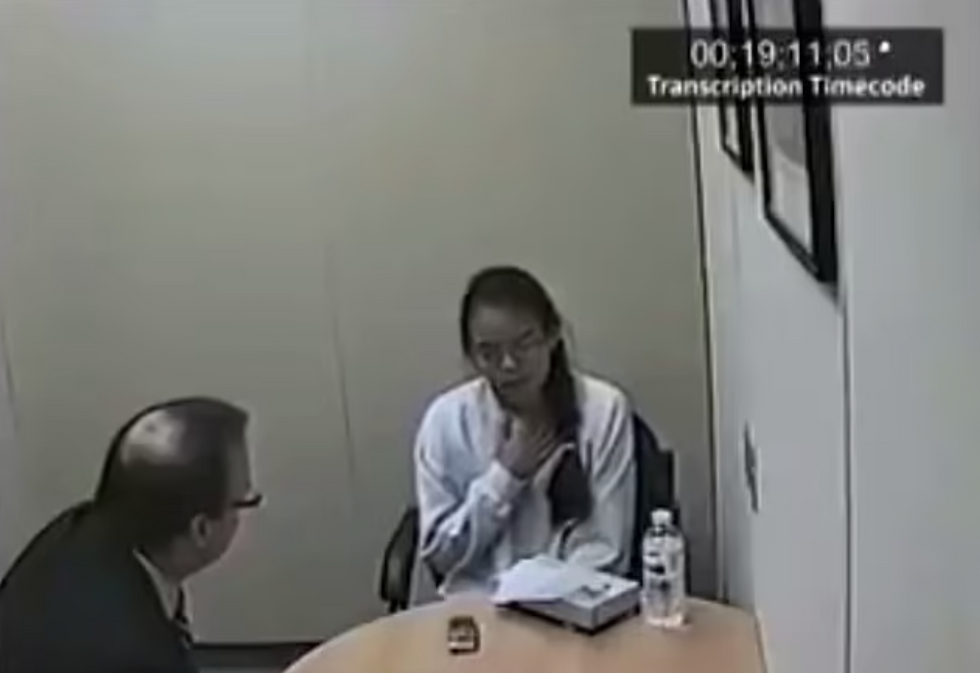
On November 22nd 2010, around two weeks after the attack, Jennifer Pan was arrested by York Regional Police.
During her police interview, investigators confronted her with the problems in her original story and the evidence they had collected.
Detective William "Bill" Goetz questioned Pan for several hours.
At first, Pan continued to deny that she had anything to do with the attack.
However, as the interview continued, her story began to change.
Pan eventually claimed that she had contacted the men because she wanted them to kill her, not her parents. She said that she wanted to die but could not kill herself.
Police did not believe this explanation and believed that her parents had been the intended targets.
Trial & Legal Proceedings

Jennifer Pan's trial began in March 2014 at the Ontario Superior Court of Justice in Newmarket.
She was tried alongside Daniel Wong, David Mylvaganam and Lenford Crawford.
They pleaded not guilty to the charges.
The prosecution argued that Pan had helped plan the attack because she wanted freedom from her parents and wanted to continue her relationship with Wong.
According to the prosecution, Pan became increasingly desperate to gain freedom from her parents. After years of lying, her parents no longer trusted her and closely controlled where she went and who she spoke to. They were also one of the main reasons she could not openly continue her relationship with Wong. The prosecution believed that this became one of Pan's main motives for wanting her parents dead.
They believed Wong helped connect Pan to the people who carried out the attack.
During the trial, the prosecution presented Hann Pan's testimony, Pan's police interrogation, phone and text records and evidence about Pan's relationship with her parents and Wong.
Hann's testimony was especially important because his account of the attack did not match Pan's original story.
In December 2014, Jennifer Pan, Daniel Wong, David Mylvaganam and Lenford Crawford were found guilty of first-degree murder for Bich Ha Pan's death and attempted murder for the attack on Hann Pan.
In January 2015, Pan was sentenced to life in prison with no chance of parole for 25 years for the first-degree murder conviction.
However, in 2023, the Ontario Court of Appeal overturned the first-degree murder convictions and ordered a new trial.
The court found that there had been an issue with the instructions given to the jury. The jury should have been given the option to consider other charges, including second-degree murder and manslaughter.
Pan's attempted murder conviction was not overturned.
The Crown appealed this decision to the Supreme Court of Canada.
In April 2025, the Supreme Court agreed with the Ontario Court of Appeal and confirmed that a new trial was needed for the murder charge.
This did not mean that Pan had been found innocent. Her attempted murder conviction remained, while the murder charge had to be dealt with again.
Media Portrayal
The Jennifer Pan case became widely covered in Canada and later internationally.
A lot of the media focused on the difference between how Pan appeared to other people and what was actually happening in her life.
She had been seen as a quiet and successful daughter while secretly lying about university, work and her relationship.
Another major focus was Pan's strict upbringing.
Her father was often described as a "tiger dad", and the case led to discussions about academic pressure, strict parenting and expectations within immigrant families.
Pan's police interrogation also became one of the most well-known parts of the case.
Videos of the interview have been shared widely online, with true-crime videos and documentaries analysing how her story changed while police questioned her.
The case became popular again in 2024 when Netflix released the documentary 'What Jennifer Did'. The documentary introduced the case to a much larger international audience and led to more discussion about Jennifer Pan and the Pan family.

Psychological Factors of the Case
Socially Prescribed Perfectionism
Pan grew up with extremely high expectations surrounding academics, piano, figure skating and her future career.
When she failed calculus and did not graduate from high school as expected, she altered report cards and later pretended to attend university and work at a hospital.
This can be connected to socially prescribed perfectionism, in which someone believes that other people expect them to be flawless and that their acceptance depends on meeting those standards, despite harmful mental effects.
Instead of admitting that she had failed to meet expectations, Pan created a false image of academic success.
Family Systems
Pan's family system involved high parental control, limited independence for Pan, and strict academic and behavioural expectations
A possible psychological interpretation is that the family became trapped in a cycle of control and concealment. The more her parents monitored her, the more Pan hid. The more she hid and lied, the more her parents felt that strict control was necessary.
This reduced trust on both sides and prevented problems from being addressed honestly.
Loss of Control
The discovery of Pan's lies created did not just create disappointment. It threatened the complete identity she had constructed over several years.
Once her parents discovered the truth, Pan faced exposure of her false identity, loss of trust, increased restrictions, and possible loss of her relationship
The plot may have been Pan's attempt to regain control over her life she believed was collapsing and escape further exposure.
Timeline
17 June 1986
Jennifer Pan is born in Ontario, Canada, to Bich Ha Pan and Huei Han Pan.
From Age 12
Her parents enrol her in activities including music theory, figure skating and flute, while placing strong emphasis on achievement.
During Grade 12
After failing calculus, Pan loses her early university admission. She begins pretending that she is attending university and later claims to have a hospital volunteer position.
8 November 2010
Three armed men enter the Pan family home. Bich Ha Pan is killed and Huei Han Pan is seriously injured. Jennifer tells police that the men attacked her parents and tied her up.
22 November 2010
Jennifer Pan is arrested. During questioning, she changes her account and says she had wanted the men to kill her, though investigators did not buy into this.
March 2014
Pan’s trial begins at the Ontario Superior Court of Justice, alongside Daniel Wong, David Mylvaganam and Lenford Crawford.
December 2014
Pan and the other defendants are found guilty of first-degree murder for Bich Ha Pan’s death and attempted murder for the attack on Huei Han Pan.
January 2015
Pan is sentenced to life imprisonment, with no possibility of parole for 25 years.
2023
The Ontario Court of Appeal overturns the first-degree murder convictions and orders a new trial, finding that the jury should have been given other verdict options to consider. Pan’s attempted-murder conviction remains.
10 April 2024
Netflix releases documentary 'What Jennifer Did'
April 2025
The Supreme Court of Canada upholds the decision ordering a new trial on the murder charge.


Comments